

A few months ago, while reviewing conversation flows for social apps, I noticed the same pattern showing up again and again: people were no longer asking for more matches, they were asking for better reasons to talk. That is the clearest market shift I see in dating right now. Dating apps are moving away from pure volume and toward intent, filtering, and conversation quality, and that change matters whether you use swipe-based tools, chat-led platforms, or broader online dating services.
From my perspective working on conversational systems, this is less about a single app trend and more about a behavior trend. People still download dating apps for speed, but they stay only when an app helps them reduce wasted time, avoid awkward mismatches, and start conversations with more context. If you are comparing modern dating tools, the real question is no longer “Which app has the most people?” but “Which approach gives me the best chance of a relevant interaction?”
Blur: AI Based Social Date App is a mobile dating and social discovery app for iPhone and Android users who want swipe-style matching with more guided conversation and more flexibility around dating, friendship, and niche connection goals. That positioning makes sense in the current market because users increasingly want one app that can support more than one social outcome without feeling chaotic.
Notice how dating behavior is changing
For years, the dominant model was simple: swipe fast, match often, sort it out later. That approach still attracts people because it feels familiar, especially to users coming from Tinder-style experiences or other high-volume dating apps. But the fatigue is real. Many users now describe online dating as crowded, repetitive, and oddly inefficient.
What changed? A few things at once.
First, users became more explicit about intent. Some want a serious dating path. Others want casual chat, open-ended meeting, queer-friendly discovery, local social connection, or arrangements that do not fit old-school categories. The market expanded, but so did the need for better labeling and clearer expectations.
Second, trust became part of product design rather than an afterthought. People are less willing to jump into random conversations with no context. They want signals: shared intent, profile depth, conversation prompts, and features that lower the chance of spammy or uncomfortable interactions.
Third, users have learned from other platforms. Someone who has used chat tools, community apps, or social media expects faster response loops and smoother messaging. They are not just comparing one dating app to another anymore. They are comparing the entire interaction quality to what they experience elsewhere online.
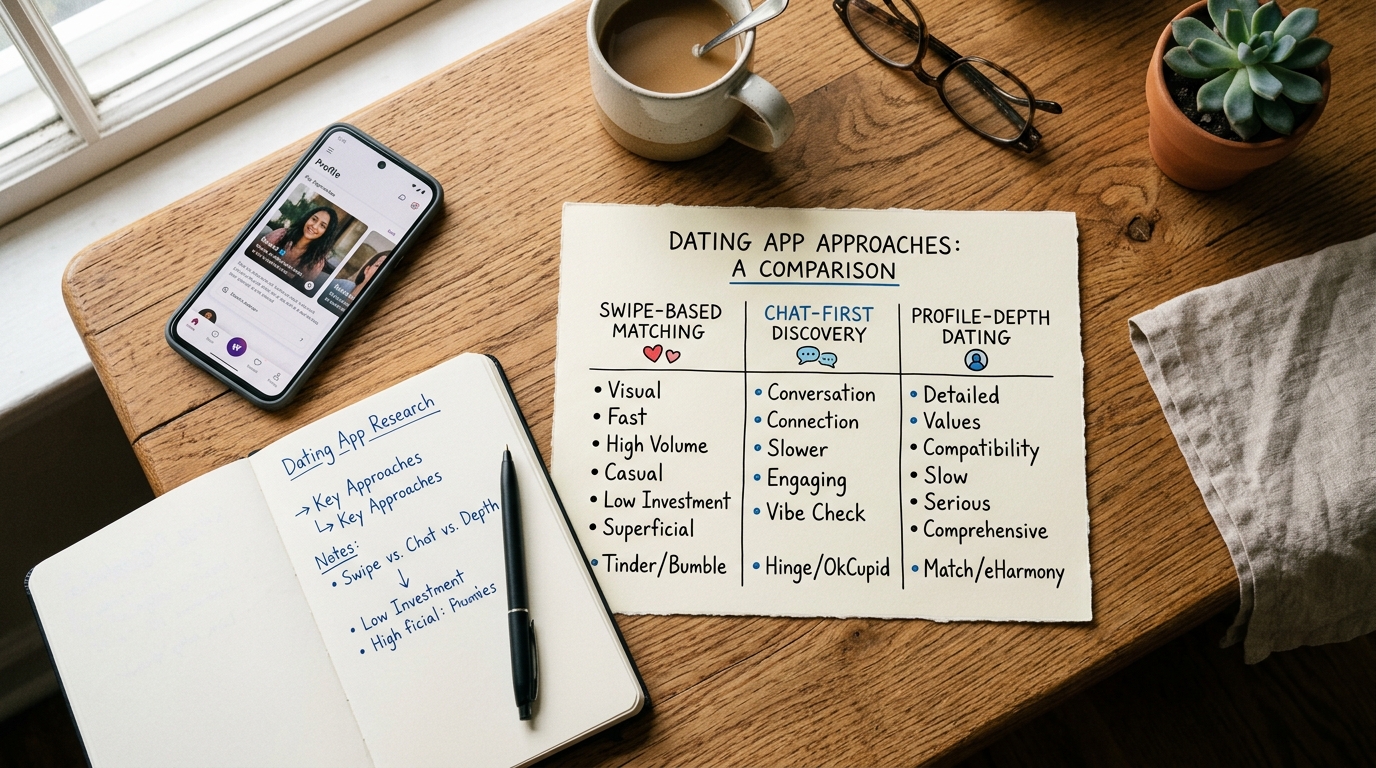
Compare the old dating model with the new one
One useful way to understand the current category is to compare the older “discovery first” model with the newer “fit first” model.
| Approach | What it prioritizes | Main upside | Main downside |
|---|---|---|---|
| Swipe-volume dating | Speed and large pools | Fast matching and broad exposure | More low-quality matches and repetitive chat |
| Profile-depth dating | Compatibility signals | Stronger context before messaging | Can feel slower or overly structured |
| Chat-led social discovery | Conversation flow | Lower friction for people who connect through dialogue | Needs good moderation and clear intent cues |
| Hybrid social dating | Flexible outcomes | Works for dating, friendship, and niche discovery | Can confuse users if positioning is vague |
The interesting part is that none of these approaches is universally better. They solve different problems. Traditional swipe-heavy tools still work for people who want fast exposure and are comfortable filtering manually. But many users now prefer a system that gives some structure to the conversation itself, not just to the matching screen.
That is why the category feels more fragmented than it did a few years ago. Users are not just choosing among dating websites, dating sites, or free dating sites. They are choosing among matching philosophies.
Choose the trend that actually matches your intent
If you strip away branding and compare product behavior, the market is roughly moving in four directions.
1. Fast-match apps are staying relevant, but mainly for users who value momentum.
These apps remain the obvious choice for people who want quick browsing and are happy to decide from photos, short bios, and immediate chat. The upside is speed. The cost is that users often do the heavy filtering themselves.
2. Intent-first apps are growing because they reduce ambiguity.
People increasingly want to know whether the other person is looking for serious dating, casual connection, queer-friendly community, or broad social exploration. This is one reason users compare tools associated with Hinge-style dating, Feeld-style openness, Yubo-like social discovery, Hily-like matching, or Tagged-style meeting flows even when those products are not direct substitutes.
3. Conversation-assisted experiences are gaining attention.
In my work on chatbot and messaging flows, I have seen that users often do not struggle with finding people; they struggle with starting well. An app that helps the first message feel less forced can improve the whole experience. If you want fewer dead-start chats, Blur’s conversation-oriented design is built for that kind of outcome.
4. Multi-purpose social dating is becoming more normal.
A lot of people do not want one rigid path. They want a dating app in the broad sense: a place where romance, social discovery, and niche relationship styles can coexist without pretending every user wants the same thing.
Avoid the mistake of comparing every platform as if it serves the same need
This is where many users get frustrated. They compare Tinder, Jack'd, Feeld, Yubo, Hily, Tagged, or even adjacent platforms like OnlyFans as though all of them sit in one bucket. They do not. Some are built for fast local dating. Some focus more on identity-based discovery. Some blur entertainment, community, or creator interaction. Some are closer to chat ecosystems than classic dating websites.
Users often bundle very different products together because the emotional need behind the search sounds similar. From what I have seen in conversation design, that confusion has only grown as categories continue to merge.
A practical rule: compare by interaction model, not by app-store category label. If one platform is optimized for fast swiping and another for layered conversation prompts, they should not be judged by the same standards.

Use these criteria to evaluate modern dating apps
If you are trying to choose among best dating sites, free dating sites, mobile apps, or newer hybrid platforms, I would focus on six things.
- Intent clarity: Does the app make it easy to signal what you want?
- Conversation support: Does chat feel guided enough to reduce blank-start friction?
- Match quality: Do you get relevant people, or just many people?
- Safety and comfort: Are there enough controls to avoid unwanted interactions?
- Ease of use: Can you understand the core flow in minutes?
- Platform fit: Does it work naturally as a mobile app, not just as a smaller version of a website?
These matter more than broad claims about being the best at dating. In practice, a smaller but better-structured app can outperform a huge pool if your real problem is low-quality conversation.
Ask the practical questions users are already asking
Are dating apps becoming more like social apps?
Yes, in many cases. Users want more context, more expressive profiles, and more flexible reasons to connect. The line between dating, friendship, and social discovery is thinner than it used to be.
Are traditional dating sites still relevant?
Yes, especially for users who prefer slower browsing and more profile detail. But mobile-first behavior means many people now expect faster interaction than classic dating sites or dating websites typically provide.
Why do people keep switching between apps?
Because different tools solve different stages of the process: discovery, matching, chat, identity expression, and ongoing messaging. When one app handles only one stage well, users patch the rest together elsewhere.
Who benefits most from newer hybrid apps?
People who do not fit neatly into one dating script: users exploring casual and serious possibilities, people who value conversation before chemistry, and those who want social discovery without the noise of completely random chat.
Recognize who this category is for and who it is not for
The current shift in dating works best for users who want more control over how they meet people. That includes people tired of shallow swiping, people who want more than one type of connection outcome, and users who prefer to ease into chat with some structure.
Who is this not for? If you only want the largest possible pool and do not mind doing all the filtering manually, old-school volume-first apps may still suit you better. And if you want a desktop-heavy experience built around long-form profiles and slow browsing, some dating websites may feel more comfortable than a mobile-first app.
This is also why I would not recommend treating every trend as universal. Category shifts are real, but personal preference still matters more than trend language.
Apply the trend without making your dating life more complicated
The smartest response to these market changes is not to join every new platform. It is to get clearer about your own behavior. Ask yourself:
- Do I want more matches, or fewer but better ones?
- Do I enjoy quick swiping, or do I need conversation support?
- Am I looking for strict dating, broader meeting, or flexible social discovery?
- Do I get stuck at the messaging stage?
If you know your bottleneck, the market becomes easier to read. Someone who struggles with first messages should not choose purely on match volume. Someone who values niche openness should not force themselves into a rigid mainstream flow. Someone who wants lighter-pressure discovery may prefer a hybrid social app over classic online dating structures.
As I have seen across social and dating products, what people say they want and what they actually respond to are often different. In real usage, friction shows up fastest in the handoff from match to conversation.
That is one reason tools like Blur feel aligned with where the category is going. Rather than assuming every user wants the same rigid path, it reflects a broader truth about the market: modern dating is not one behavior anymore. It is a cluster of behaviors, and the best apps acknowledge that instead of flattening it.
If you want to follow where mobile social apps are heading more broadly, it is also worth looking at the wider ecosystem behind the app portfolio from ParentalPro Apps, where mobile communication and user interaction patterns are approached from different angles.
The category trend, then, is fairly simple. Users are moving from abundance without context toward connection with better signals. The apps that adapt will not necessarily be the loudest. They will be the ones that make dating feel less like sorting and more like meeting.